
Being a paper prepared by Tosin IGE, Proshare LLC,” as a subtheme of “Insurance: Untapped Goldmine” for the NCRIB 2024 National Insurance Brokers Conference and Exhibition (NIBC&E) themed “Renewed Hope for Food Security Through Insurance“, held on Tuesday, October 29, 2024, at Banquet Hall, State House, Aso Rock Villa, Abuja.
This note discusses how contemporary insurance solutions can be deployed to achieve a considerable level of food security in Nigeria by addressing current challenges, closing coverage gaps, and fostering innovative solutions through collaboration between public and private operators.
Outline:
. Nigerian Household and The Question of Food Security
. The Renewed Hope Agenda and the Promises of Food Security
. Insurance Industry and Food Security: Identifying the Gaps
. Nigeria’s Food Security Gaps: Bridging the Gaps with Workable Insurance Solutions
. Closing Thoughts: The path forward.
Nigerian Household and The Question of Food Security
Nigeria’s recent economic policies, such as subsidy removals and FX liberalisation, have been aimed at macroeconomic stabilisation. However, the brunt of these shifts has so far been absorbed largely by households, which serve as the common denominator in the economy. With a focus on economic transformation, policy changes have caused inflationary pressure that reduces purchasing power, directly impacting household welfare. Nigerian households now contend with skyrocketing prices of essentials as wages struggle to keep pace, pushing many below the poverty line.
While subsidy removals aim to redistribute resources toward infrastructure, the immediate impact on household budgets has been severe, with the cost of necessities, including food and energy, rising sharply and disproportionately affecting low- and middle-income households. Among other measures, the policy-induced economic shocks have forced some households to adopt austerity measures, including cutting back on nutrition and relying on credit. This results in a survival-based approach to budgeting that delays productive investment, such as education and skill development, necessary for long-term stability.
For instance, a hypothetical household with a salary of N70,000 or above has basic expenses, including rent, transportation, feeding, and utilities, which have risen significantly, with rates of change ranging between 50 and over 200% since May 2023. The increase has led to a budget deficit that has steadily grown, yet interest rates remain elevated at over 30% as of October 2024, further compounding the household woes
(see illustration 1 below).
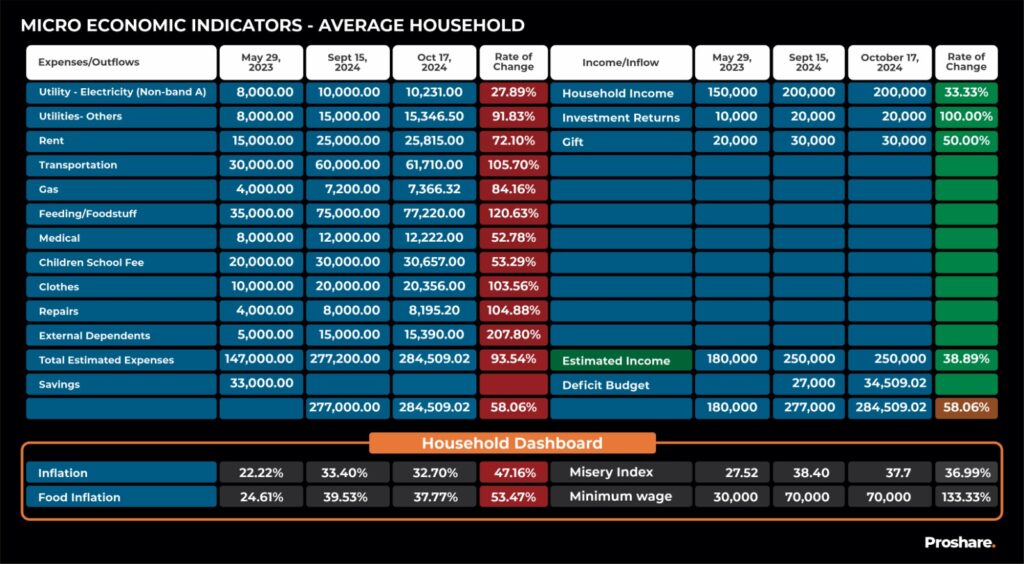
Rising food prices, combined with stagnant incomes, threaten household food security. Income levels have failed to adjust proportionally to inflation, leading to a growing affordability gap, where families make difficult choices about meal quality and quantity.
These conditions have intensified food insecurity in Nigeria. According to a 2024 Policy Brief by the NESG, “The number of food-insecure Nigerians increased significantly, from 66.2 million in Q1 2023 to 100 million in Q1 2024, with 18.6 million facing acute hunger and 43.7 million Nigerians showing crisis-level or above crisis-level hunger coping strategies as of March 2024.“
Although generally attributable to high inflation, supply chain disruptions, and a lack of robust social safety nets, Proshare analysts have argued that the low productivity of the country in food production and other essentials is a reinforcing factor of food insecurity, with attendant low/poor seedling, post-harvest losses on storage and logistic ineffectiveness, mechanisation gap, and aggregation problem, among others.
The resultant structural issues, coupled with the general quest for high monetary gains with low outputs, incoherent agricultural policies, weak infrastructure, and weak investment in the sector, have limited food production and accessibility, which has led to increased dependence on food imports and further exposes us to global price shocks.
Climate change and man-induced disasters, particularly flooding and farmers-herders crisis, further complicate domestic food availability. While the year-long crisis between farmers and herders remains, recent floodings have destroyed vast tracts of farmland in the middle belt to the northern regions, reducing crop yields and increasing food prices. With agriculture providing the primary income for many rural households, the flooding has directly impacted their livelihoods and the broader food supply.
The Renewed Hope Agenda and the Promises of Food Security
The Renewed Hope Agenda of President Tinubu presented agriculture and food security as one of the key areas of interest, with its many policy interventions in the sector
(see Table 1 below).

Insurance Industry and Food Security: Identifying the Gaps
Agribusiness, the major source of food in Nigeria, is bedevilled with a web of risks that affect food security, as highlighted above. These risks arise from the very wild acts of nature, man-made disasters, pests and disease infections, among others, which challenge agricultural stability and productivity.
Economic risks arise from policy shifts, fluctuating prices, input costs, and financial uncertainties, which create a challenging environment for farmers to operate, leading to substantial production losses.
In managing these risks, agricultural risk management experts say agribusinesses rely on a mix of on-farm and risk-sharing strategies.
On-Farm Strategies
This includes collecting information for decision-making, adopting diversified crops to stabilise income, integrating weather-resistant technologies such as irrigation, and utilising flexible production techniques.
Off-Farm Strategies
These strategies are mainly for financial resilience, including tools like formal insurance policies, forward trades, and financing solutions.
Managing the risks with insurance policies hedges against adverse nature and market impacts and enables better preparation for extreme events, which helps safeguard both crop yields and the broader agricultural supply chain.
The insurance industry, although low and unstable in outputs and contribution to GDP (see chart 1 below), plays a key role in managing food security risks, if properly deployed to fit purposes.
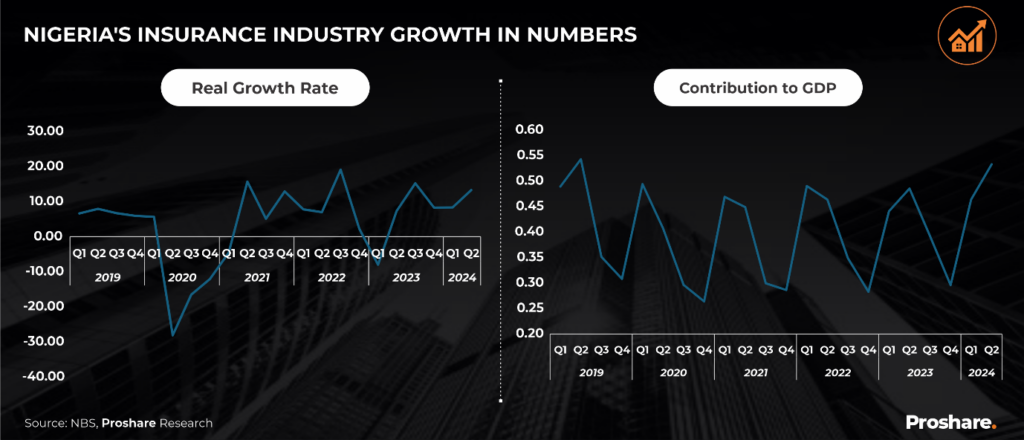
Though vital in managing food security risks, there are significant gaps in insurance coverage that leave many farmers vulnerable to losses within the current construct of climate and man-made disruptions.
As a risk-sharing tool, insurance enables farmers to spread risk by paying premiums, allowing compensation in cases of adverse events. However, despite the potential of agricultural insurance to protect against production and financial losses, there are challenges in reaching smallholder farmers.
Gaps in Leveraging Insurance for Food Security
- Interventions in the agricultural sector are mostly done without an insurance system to manage the risks involved.
- Under the Nigerian Agricultural Insurance Corporation (NAIC), existing insurance schemes lack adequate reach, especially among smallholder farmers, which restricts the majority of rural farmers from benefiting from these protections.
- Agricultural insurance has been primarily supported by government subsidies, which face sustainability challenges due to low budgetary allocation. This limits long-term stability and makes scaling to meet growing demand difficult.
- Limited involvement of private insurance providers in the agricultural sector reduces options for comprehensive coverage and specialised insurance products tailored to different farming needs and risks.
- Domestic insurance products somewhat lack precise, data-driven mechanisms for assessing risks associated with specific crops, regions, and climate conditions, making payout difficult and reducing farmer trust and uptake.
- Crop revenue insurance, which relies on stable commodity exchange markets to set reference prices, faces challenges despite the existence of commodity exchanges. This has limited the ability to offer revenue-based insurance that could protect farmers against income volatility during crop cycles and other disruptions.
Nigeria’s Food Security Gaps: Bridging the Gaps with Workable Insurance Solutions
A few agricultural insurance options can effectively mitigate food security risks in Nigeria, helping to stabilise food production amidst uncertain conditions.
According to a report on Agribusiness risk management in Nigeria by Abolade Isaac Agbola, Prof Sulaiman Yusuf, and Dr Tunde Oluwalaiye, classified agricultural insurance products into three groups:
- Indemnity-Based Agricultural Insurance, where claims are assessed based on the actual losses/perils experienced by the farmer or policyholder, with compensation calculated individually for each insured party.
- Index-Based Agricultural Insurance, where claims are linked to a specific, independently measured parameter that correlates closely with potential losses a farmer may experience.
- Crop Revenue Insurance protects farmers against revenue losses from their crops, with revenue calculated as the product of crop yield and market price. It covers revenue drops below an expected level determined by futures market prices and applies only when a stable commodity exchange exists.
Although these tools offer tailored protection, from covering specific perils to providing payouts based on production indices, which allow farmers to recover quickly from adverse events, they are conditional on the financial capacity of the farmers, which may not be robust in the current high-cost environment.
Public-private partnerships (PPPs), in a tripartite fold of government, insurance companies, and farmers, provide an important option to de-risk the country’s food supply chain, stabilise food production, increase productivity, and broaden “agric-insurance” reach. The participation of government entities and increased budgetary allocation to the sector, channelled through professional agriculture extension and advisory companies, can increase investment inflows and de-risk the sector from its multiple threats and disruptions.
Notably, an unstructured or improperly implemented public sector involvement in the sector is more of a disruption or disaster in itself. For instance, recent policy interventions in the sector under the erstwhile CBN leadership yielded no significant benefits but created disruptions. The collaboration of insurance companies in the PPP offers risk and liability sharing that makes production more affordable and return guaranteed for farmers. PPPs can also facilitate fund mobilisation for agricultural insurance schemes, such as subsidising premiums for smallholder farmers or creating agricultural relief funds that insurers and the government jointly manage. PPP arrangements can also be stretched to resilience-building initiatives, including climate adaptation programmes, flood control measures, and drought-resistant crop development, which reduce financial exposure and enhance food production capacity.
Concurrently, innovative/tech-enabled insurance solutions can be deployed to de-risk agribusinesses and food production chains. Insurers can create innovative products that cater for the concerns of both smallholders and commercial farmers, including streamlining government spending on agricultural extension programmes, investing in research and development, and supporting farmers across the value chains. At a July Edition of WebTV Economy and Politics Show, an industry expert, Dr Bolade Agbola of Lam Agro Consult, identified tighter security for farmers and a restructuring and recapitalisation of the Bank of Agriculture (BoA) as key alternative interventions to strengthen the country’s food security. He noted the need for the Bank of Agriculture to be structured as a deposit-collecting bank with innovative solutions and branches nationwide. He says such reforms are innovative products and services that will boost productivity and overall outputs.
The path forward
The path to achieving food security in Nigeria is complex and requires deliberate efforts across sectors beyond the agricultural sector alone, especially as the country faces unprecedented economic challenges. Inflation, rising food costs, and stagnant incomes have eroded households’ purchasing power and increased their vulnerability to food insecurity. As such, bridging the food security gaps in Nigeria requires a whole-of-government approach to policy reforms that integrate policies across relevant sectors to de-risk the sector and enhance food productivity.
Addressing the structural gaps in leveraging insurance services for food security is imperative. This will require innovation and policy consistency, reducing dependence on unstructured government subsidy schemes, incentivising private insurers’ participation, and advocating for the greater use of commodity exchanges. Moreso, incentivising sustainable practices through premium discounts will see insurers contributing to creating a more resilient agricultural sector that meets the needs of rural smallholder farmers spread across the country and increases overall food outputs.
For feedback and further information on insurance sector updates, kindly contact research@proshare.co